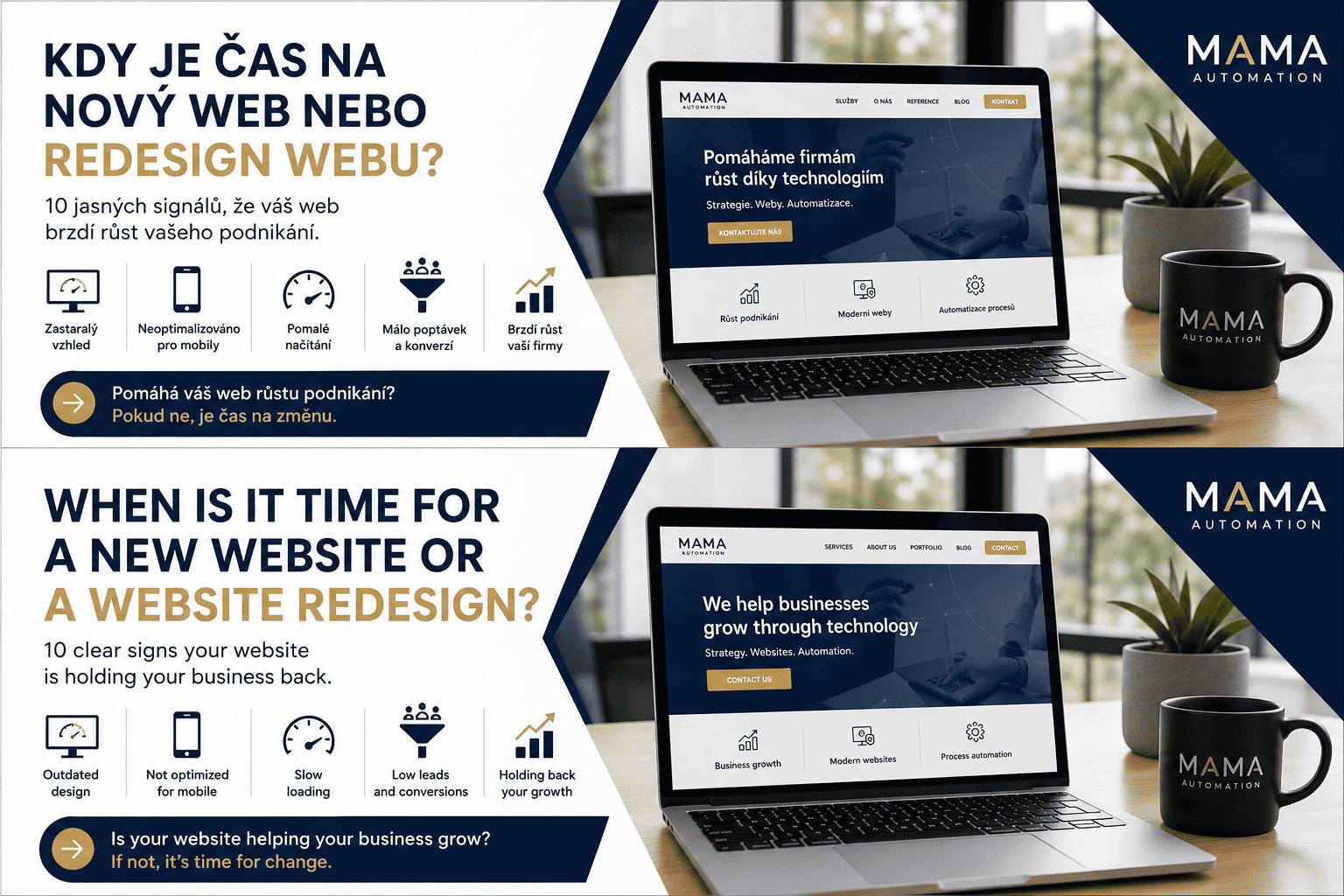
Your Website Could Be the Biggest Obstacle to Your Business Growth
Many business owners focus on advertising, social media, or finding new sales opportunities while overlooking the place where most potential customers form their first impression—the company website.
Today, a website is much more than an online business card. It is a business tool that determines whether visitors become customers or leave for a competitor. If your website looks outdated, loads slowly, or no longer meets modern user expectations, it could be costing your business valuable leads every single month.
At Mama Automation, we believe that technology should always support business growth. A beautiful website alone is not enough. Your website should actively help your business achieve its goals.
Many entrepreneurs also assume that a website redesign simply means refreshing the visual design. In reality, it is an opportunity to eliminate the issues that slow business growth—from poor user experience and weak credibility to limited search engine visibility.
This article will help you identify ten practical signs that indicate it may be time to invest in a completely new website or redesign your current one.
The MAMA Framework: 10 Signs Your Website Needs an Upgrade
Instead of asking:
“Is our website old?”
ask a much more important question:
“Is our website helping our business grow?”
If the answer is anything other than a confident “yes,” review the following ten areas.
1. Your Website Looks Outdated
First impressions are formed within seconds.
Modern customers naturally associate the quality of your website with the quality of your business. If your design looks like it belongs a decade ago, visitors may assume your services are equally outdated.
Common warning signs include:
- outdated visual design,
- cluttered navigation,
- inconsistent branding,
- too much text,
- low-quality images.
For many companies, a website redesign is the fastest way to rebuild credibility.
2. Your Website Doesn’t Work Well on Mobile Devices
More than half of today’s visitors browse on smartphones.
If users need to zoom in, struggle to navigate, or wait too long for pages to load, many will simply leave.
Modern professional websites should be designed with mobile users as the highest priority.
3. Your Website Loads Too Slowly
Every additional second increases the chance of losing a potential customer.
Slow websites negatively affect:
- user experience,
- trust,
- search rankings,
- lead generation.
Building a new website should therefore focus not only on appearance but also on technical performance, optimized images, clean code, and fast hosting.
4. Visitors Don’t Become Leads
Are people visiting your website without contacting you?
This often indicates that your website isn’t guiding visitors toward the next step.
Common issues include:
- unclear calls to action,
- confusing navigation,
- weak value proposition,
- lack of trust signals or testimonials.
We discuss this topic in greater detail in our article about why business websites fail to generate leads, where we explain the most common conversion mistakes and how to fix them.
5. Your Website No Longer Reflects Your Business
Businesses evolve.
Services expand.
Target audiences change.
New expertise develops.
Unfortunately, many websites remain exactly the same.
As a result, they represent a company that no longer exists.
If your business has changed significantly over the past few years, it may be time to evaluate whether your website still supports your current goals.
6. Updating Content Is Difficult
Does every small text update require a developer?
Then your website is limiting your business instead of supporting it.
Modern professional websites should allow business owners to update common content quickly without technical knowledge.
If changing a phone number or adding a new service takes days, your platform is likely holding you back.
7. Your Website Wasn’t Built for SEO
Even the best products cannot generate customers if people cannot find you online.
Common SEO problems include:
- missing metadata,
- poor heading structure,
- slow loading speed,
- unoptimized images,
- weak internal linking,
- technical indexing issues.
When building a new website, SEO should be part of the project from day one—not something added after launch.
If you’d like to learn more, read our article on how content marketing and SEO attract more customers.
8. Your Competitors Look Far More Professional
Customers rarely judge your website in isolation.
Instead, they compare it with several competitors before making a decision.
If competing companies offer:
- cleaner design,
- faster websites,
- better explanations,
- stronger credibility,
- simpler contact options,
they already have an advantage before the first conversation even begins.
A website redesign is not about having the most beautiful website—it’s about remaining competitive.
9. Your Website Cannot Support Future Growth
Perhaps you’re planning to:
- launch a blog,
- integrate CRM software,
- automate lead management,
- add online booking,
- create a customer portal.
If your current platform cannot support these plans—or upgrading it is prohibitively expensive—it may be time for a modern solution.
Your website should grow together with your business.
At Mama Automation, we always design websites with future growth in mind. If you’re also planning to automate business processes, our Business Automation service can help connect your website with your everyday operations.
10. You No Longer Feel Proud to Share Your Website
Perhaps the clearest sign of all.
Have you ever sent someone your website while saying:
“Please ignore the website—we’re planning to redesign it soon.”
If you don’t feel confident sharing your website, your customers probably notice that too.
A professional website should become one of your strongest business assets.
The MAMA Decision Model: Fix, Redesign or Build a New Website?
Minor improvements are enough if:
- your design still feels modern,
- your website performs well,
- mobile usability is good,
- your website generates leads,
- you only need content updates.
A website redesign makes sense if:
- the technology still works,
- you need a modern appearance,
- user experience requires improvement,
- you want higher conversion rates.
A completely new website is usually the better option if:
- the technology is outdated,
- future expansion is difficult,
- maintenance costs are increasing,
- your business has significantly evolved,
- you’re planning long-term digital growth.
This simple framework helps you make business decisions instead of emotional ones.
Common Mistakes
Many business owners postpone redesigning their websites.
Typical reasons include:
- “It still works.”
- “We’ll do it next year.”
- “We have bigger priorities.”
- “Customers will find us anyway.”
Meanwhile, the business continues losing opportunities because its website no longer builds trust or converts visitors into customers.
A professional website is not simply an expense.
It is one of the few business assets working for you every day.
FAQ
How often should a website be redesigned?
There is no fixed rule. However, many businesses significantly redesign their websites every three to five years or whenever their business changes substantially.
Should I redesign my website or build a completely new one?
It depends on the technical condition of your current website. If the underlying technology limits future development, building a new website is often the better long-term investment.
How much does a professional website cost?
Pricing depends on project complexity, required functionality, content, and integrations. More importantly, a high-quality website should generate business value that exceeds its initial investment.
Can a new website improve SEO?
Absolutely. A well-designed website improves loading speed, technical SEO, user experience, and content structure, creating better conditions for long-term organic growth.
Conclusion
Your website should actively support your business—not simply exist online.
If several of these warning signs sound familiar, it is probably the right time to consider a website redesign or invest in a new website that reflects your company’s current ambitions.
If you’re unsure where to start, explore our Website Development service, read our articles about why websites fail to generate leads and how content marketing attracts customers, or simply contact Mama Automation through our Contact page. We’ll help you evaluate your current website and recommend the most effective next step.